I was sixteen when I first heard the call to be a rabbi. Holding my guitar, I stepped into the Alzheimer’s unit at my grandmother’s nursing home. When she slumped in her chair and struggled to engage, I suggested we go to the social hall to sing her favorite Jewish melodies. As I played, her eyes lit up, and she sang with a vibrancy I didn’t know she still had. Soon, other families joined, watching tearfully as their previously subdued loved ones sang and clapped along. We sang, cried, laughed, and reminisced. In just a few minutes, we had become a sacred community, enabling our loved ones to shine.
That was the moment I knew I needed to be a rabbi. I wanted to facilitate sacred moments of connection, foster Jewish community, and nurture individuals on their spiritual journeys. More broadly, my vision as a rabbi is to help people engage deeply with Judaism in ways that foster spiritual growth, nurture inclusive communities, and bridge tradition with innovation.
While in seminary, I had the opportunity to do just that. My husband and I moved to a new neighborhood only to discover that there was no Jewish community for the influx of young Jews. A classmate and I began hosting Shabbat services in our living rooms, unsure if anyone would come. Slowly, our gatherings grew into the Wandering Jews of Astoria, a warm, creative community where we celebrated holidays, learned, volunteered, and supported one another through life’s ups and downs. I will never forget crafting a baby naming for a child whose parents had met through our minyan, wrapping her in a tallit as family and friends showered her with blessings. Seventeen years later, the community continues to thrive.
During my fourteen years as a congregational and now campus rabbi, I have been blessed to connect with extraordinary people at pivotal moments in their lives. When “people relate to each other authentically and humanly,” Martin Buber once wrote, “God is the electricity that surges between them.” Each time I open the door for a student to connect with their Jewish identity, officiate a wedding, bless a newborn, celebrate with a B’ Mitzvah family, or welcome a Jew by choice into the covenant, I feel that electricity. I am humbled by the privilege of offering guidance and comfort in moments of vulnerability, whether holding a hand in a hospital room, consoling mourners, or counseling through life’s challenges.

I certainly felt that way when a family approached me after 32 years of caring for their son with a degenerative disease. They wanted to honor him by bringing visibility to those living with chronic illness. Together with liturgist Alden Solovy, we created a new blessing that now circulates widely. People still reach out to share how meaningful it is to have a Jewish prayer that speaks to their experience. This is what my rabbinate is all about: helping people feel seen, nurtured, and supported on their spiritual journeys, living into their Jewish identities in ways that are personally fulfilling.
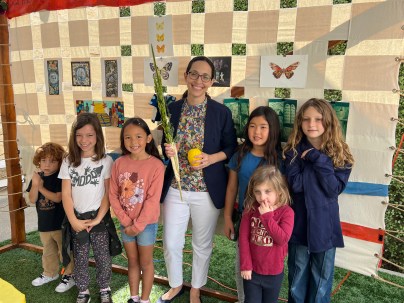
In my current role, I work to bring sacred community to the college campus through joyful, music-filled Shabbat experiences, creative programs like Torah and Tempo and HanukkahFest, and one-on-one conversations that meet students where they are. Whether counseling a student in crisis, mentoring emerging leaders, or supporting faculty through difficult moments, I have seen how spiritual care and Jewish presence can transform campus culture. My rabbinate also calls me to advocacy, interfaith dialogue, and education. I convene clergy across faiths, lead efforts to confront antisemitism, and foster nuanced, values-based conversations about Israel and Jewish peoplehood. Through dialogue, partnership, and a spirit of curiosity and compassion, I strive to ensure that Jewish students and faculty feel seen, safe, and supported, and that every student knows they belong and that their voice matters.
I am at my best when I create opportunities for children to explore their Jewish identities through escape-the-room tefillah, games, conversations, and hands-on learning; when I gather families to bake challah, design innovative Hanukkiah creations, make tallitot, or take B’ Mitzvah families on a “Hike Up Mt. Sinai.” I love teaching adult classes on topics ranging from Mussar to Female Heroines of the Torah. Last year, I was blessed to lead an incredible Adult B’ Mitzvah class. As we discussed prayers and theology, the 14 participants began to open up to one another, sharing their questions about Jewish identity and faith. They voiced insecurities and reflections on each of the prayers we covered. They shared art that they created and psalms that they wrote. The contributions sparked conversations filled with renewed depth and inspiration.
These are the moments in which Rabbi Hanina’s words from the Talmud ring true: “I have learned much from my teachers and even more from my friends, but from my students, I have learned the most.” According to Pesikta de Rav Kehana, there is a reason God reveals the Ten Commandments in the presence of the entire Israelite community. Each person received the Torah in their own way, based on personal experience, talent, and insight. Everyone has a unique Torah to teach. When people express and live their Torah, the entire community is richer for it. In my work with students, families, and congregants, I see how teaching, guidance, and support in everyday life bring this philosophy to life.
At its heart, my rabbinate is about helping people find meaning through connection—to each other, to Torah, and to something greater than ourselves. Whether in the nursing home or the university, in my living room, the sanctuary, or at an interfaith table, I have been blessed to share holy moments with others as we navigate life’s journey together. Every encounter, every teaching, and every blessing reminds me that holiness is discovered in the space between us. I look forward to the relationships, learning, and growth the next chapter will bring.

